 Share

Trusting the water
How safe can you feel in the world if you cannot float in the liquid that makes up a large part of your body? In YOU CANNOT CAN, presented at St. George Care as part of Moving in November in Autumn 2026, live artist Dana Michel brings this question into the swimming pool. In conversation with the festival’s Artistic Director Kerstin Schroth, she reflects on taking time, learning to trust, and inviting audiences to find their own way. The performance is organized in collaboration with cultural center Caisa.
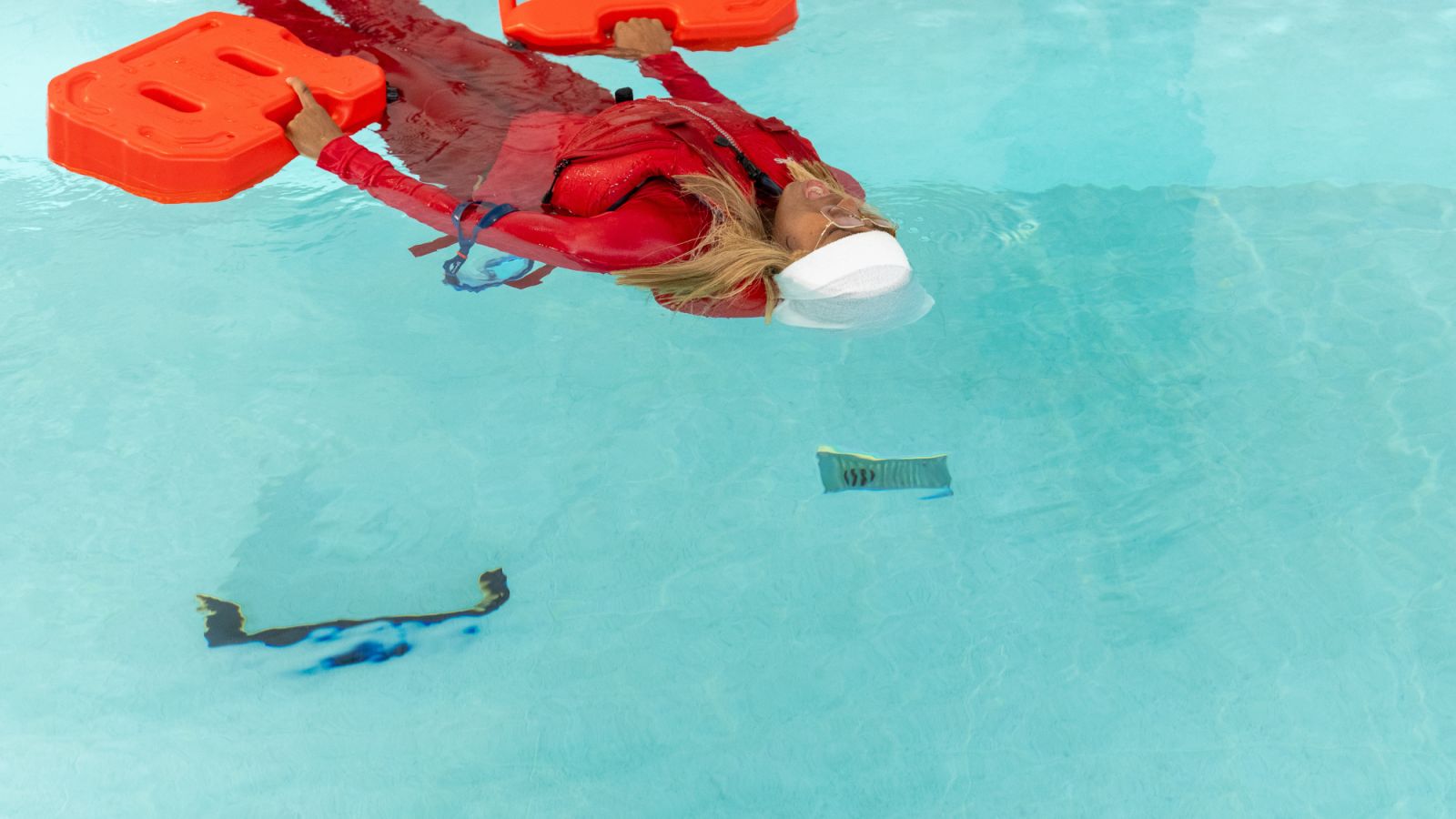
The Montréal based live artist Dana Michel is a known face and has a long history with both Moving in November and Helsinki. Her previous works YELLOW TOWEL (2014), MERCURIAL GEORGE (2016), CUTLASS SPRING (2019), and MIKE (2023), shown in the frame of Moving in November, have been influential performances—points of references to the Finnish performing arts scene. This year, Michel returns to Helsinki with YOU CANNOT CAN, a new solo performance in a swimming pool.
The beginnings of a piece for a swimming pool
When asked to share more about the process, Michel first remembers speaking about YOU CANNOT CAN in May 2019, during the premiere week of CUTLASS SPRING in Brussels at Kunstenfestivaldesarts. At the time, questions of trust were meeting a very tangible experience: taking her child to swimming lessons.
Michel: “Yes, what was fresh and very present at that time was me reflecting on how much it took for me to trust people. Which led me to thinking about how much I trusted myself. Which led me to think that I needed to do something about the low low low trust levels that I was detecting. Which led me to thinking ‘PROJECT’. And at around the same time in life, my kiddo was taking weekly swim lessons. And I was having a lot of buried pool-environment angst flooding my system every Sunday morning that I brought him to the pool…the wetness, the noises, the temperatures, the ‘damn it I’m in my forties and I STILL CAN’T SWIM’. Which led me to thinking ‘PROJECT’. I’m prone to needing to do more than one thing at a time.”
Time rarely behaves according to plan
Though having premiered 2026, she started thinking about this performance already several years ago. For Michel, a performance begins long before it meets an audience. Her processes need time to unfold—and time rarely behaves according to plan, says Michel.
“I really like or need for every process that I undertake to unfurl over some kind of extended time. I mean, it feels like whatever amount of time is allotted for something…just imagine that generally I feel like I need the double but really the triple. I just really need to move very slowly in order to absorb everything that I feel I need to absorb in order to feel as though all of me is actually mostly fully involved in whatever it is that I am doing. And any amount of time that I allot for myself is also never even close to being enough.”
And it is not just counting for her artistic work: Michel tells that even the smallest daily routines can open into something else despite practical planning of how each day could or should go. Daily routines like brushing teeth might end up interrupted halfway through, for a need to make a note about something, and then to go lie down to process the note itself.
“There is always SO MUCH TO SEE DO THINK FEEL HEAR SMELL along the way and hierarchies are not a part of my heartscape.”
Last time Michel was in Helsinki in 2023 with the solo MIKE, a three-hour site-specific performance starting with the question: If we cannot be ourselves at work, where we spend most of our lives – what kind of lives are we living? To look for the answer, she created a performance—a meditation on the work environment, transforming daily actions into choreographic experiments. Here, too, every action was interrupted, seemingly losing its fluidity, by her shifts of attention.
Trusting the water, trusting yourself
“Anyway, it suddenly seemed very impractical indeed to be a person who could not reasonably assure themselves of being able to continue to live if submerged in certain kinds of water conditions without the assistance of others. And yes, you know, once I open a tab - I’m gonna need to open a bunch more tabs. It’s like eating chips. I munched on ‘ouf, I better learn to swim’. I munched on ‘ouf, OBVIOUSLY I better learn how to swim, hello? I am a water sign! I am made of water! Not trusting water means not trusting me! Uh oh.’ PROJECT.”
Gradually, these two concerns began to come together. Thinking about trust and learning to swim seemed to belong to the same project.
“They felt like a good fit, thinking about trust and thinking about swimming seemed to definitely go together.”
For Michel, being unable to swim raised a very practical question that stands in the heart of the new performance: How safe can you feel in the world if you cannot float in the liquid that makes up a large part of your body.
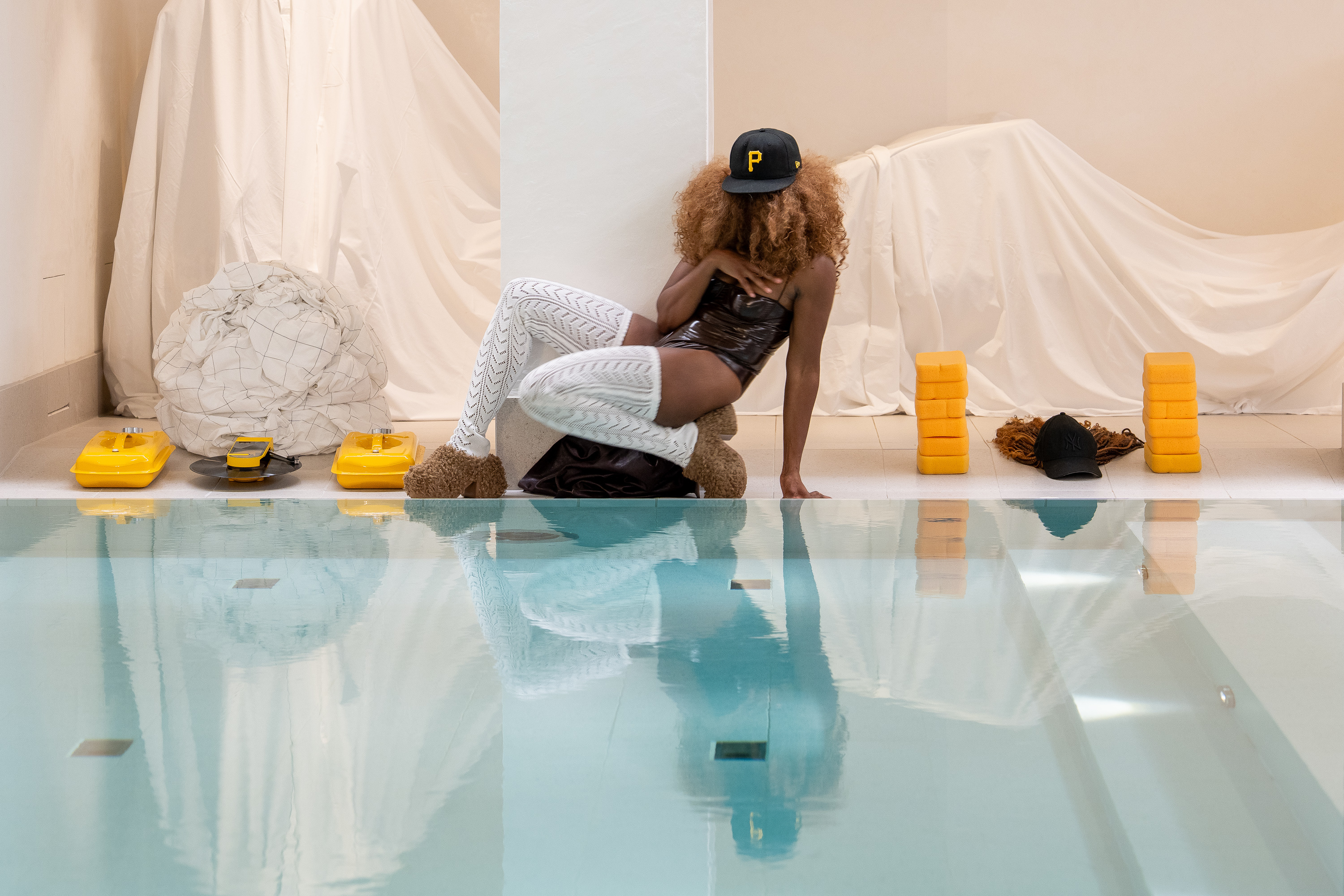 Dana Michel performing at St. George Care. Photo by Petri Summanen.
Giving a feeling pointing to an atmosphere
The promotional photographs of YOU CANNOT CAN show beautiful pools and surfaces of blue water, invite imagination before the performance begins. For Schroth, their visual appeal creates a tension with the subtlety of the work itself and the content it addresses. Asked about this relationship, Michel shares her view upon the expectations created by descriptions of art.
”Yes, so the first thing that comes up for me is to think that this is the danger of descriptive texts and what they are expected to read like. You know, if it were up to me I wouldn’t give one. Well, that’s not totally true. I would much prefer to give texts that give a feeling about something, that maybe just points to an atmosphere of thoughts rather than texts that try to describe what the work is about.”
Michel herself does not rely on a description text to point her to the right direction, while visual material, like images and video clips, will more likely guide her in making a decision whether or not to go to see an artwork.
“Okay, and of course the first thing that draws me in is looking at the picture, the promotional image. That’s what is mostly gonna help me decide whether I should further investigate. Then I have to watch the trailer and I will be able to glean sooooooo much information from that trailer. All that delicious texture and soundscape to help point me in the ‘right’ direction”, says Michel
Going on an adventure
Michel wants to invite audiences into an experience without determining in advance what they should find there. Images, sounds and words can open a door, but they don't need to guarantee that what follows will match expectations. Instead, Michel hopes to offer an adventure in which people can find their own way through the work, bringing their own memories and associations into the experience.
“I really really really try hard to offer the opportunity for people to create their own way and to just be able to experience what is happening in the moment and to invite along their own memories. In performance, I really try to reflect the non-linearity that is experiencing being alive, you know? There is actually just sooooooo muuuuuuch content shoved inside of these teeny projects because that’s what every moment of being alive feels like - for me anyway!”
The invitation remains open, even when the expectations surrounding a performance do not quite align. What artists, presenting bodies, and audiences might expect or want to say about an artwork will not necessarily match: there are many competing desires, needs, and realities, and the demand for sense-making stands strong. Resisting this practicality, Michel insists on inviting curiosity into the space, opening up for getting lost, and letting go of preconceptions.
“How to make it all match? It doesn’t match! It’s an eternal quest, this trying to figure out how to just invite people to be curious, to let go into the swirl of possibility and to not close themselves off into preconceptions or strict sense-making. We are sooooo hungry for sense. It’s practical.”
The text is based on a written conversation between Dana Michel and Moving in November’s Artistic Director Kerstin Schroth, held in early autumn 2026.
SHARE THIS ARTICLE



Read next
Hybrid Season – How Nordic rhythm, modern fitness and mindful recovery align
St. George TALK: Tuomas Hämäläinen – Champion of Cocktails
Thursday 03 December, 2026
Glögi Night 18 Dec 2026 at St. George Bakery
Friday 18 December, 2026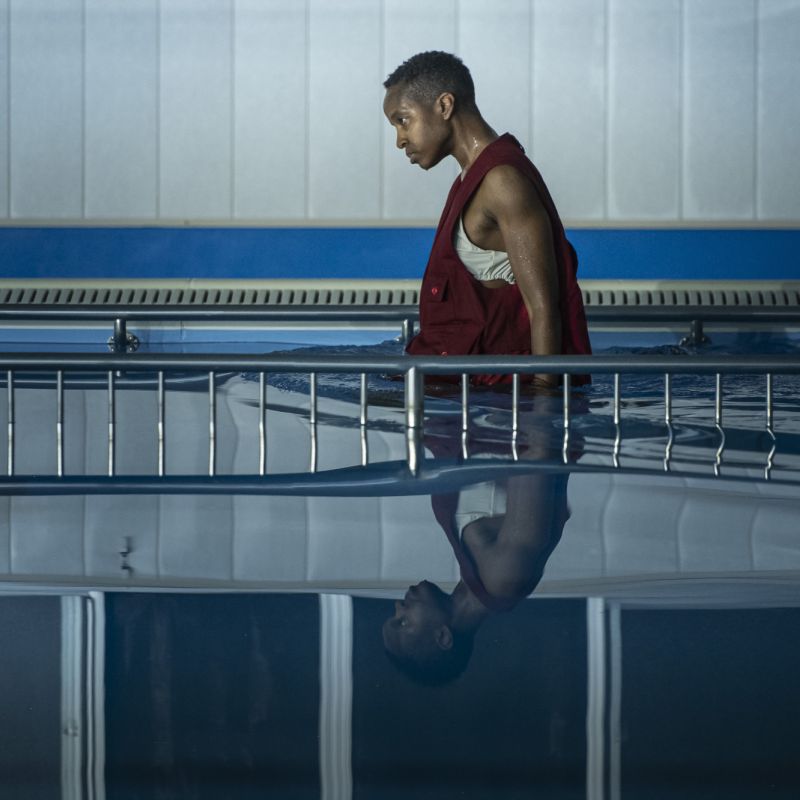
Moving in November presents Dana Michel – YOU CANNOT CAN
Monday 09 November, 2026
A picnic is a state of mind: How Wintergarden is redefining Saturday brunch
Moonlight Swim at St. George Care on 30 Oct, 14 Nov & 11 Dec
Friday 30 October, 2026
4 x Micro-adventure in Helsinki – How to spend a perfect, carefree summer day
If you go down to the woods today – The 6 best nature destinations around Helsinki
St. George Bakery: Cocktail Brunch 14.–16.8.2026
Friday 14 August, 2026
Night of the Arts 2026 at St. George Bakery
Thursday 20 August, 2026
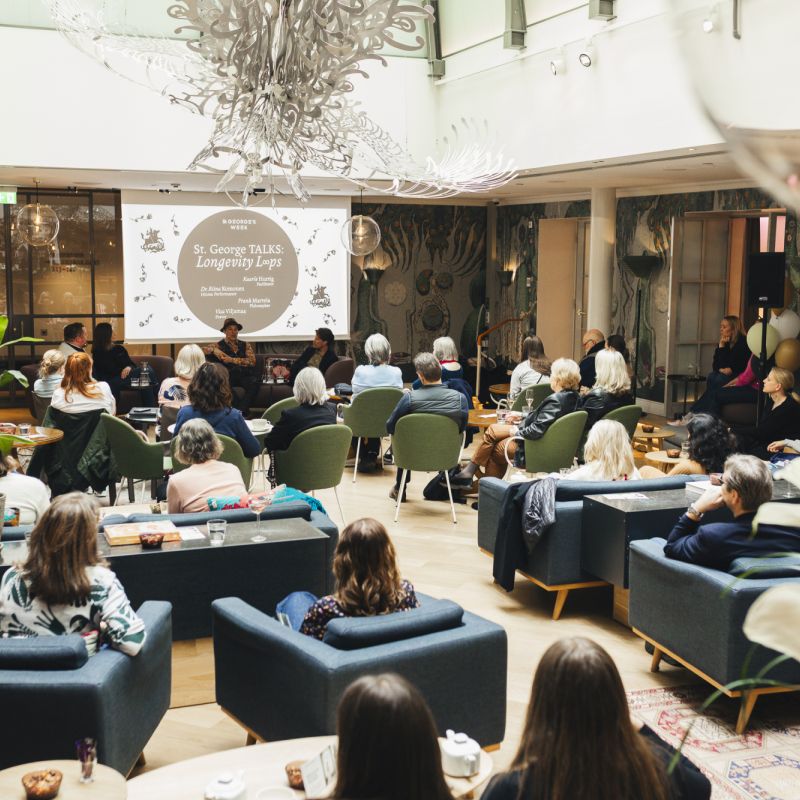
St. George TALKS: Longevity L∞ps – Perspectives on the good life and meaning
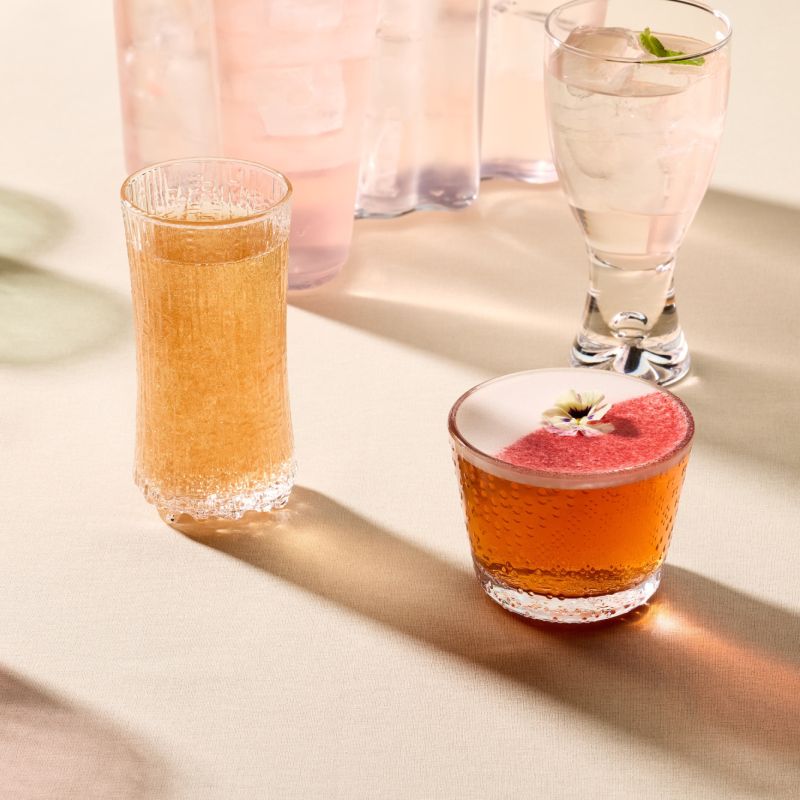
Iittala at Wintergarden – timeless design finds a new context
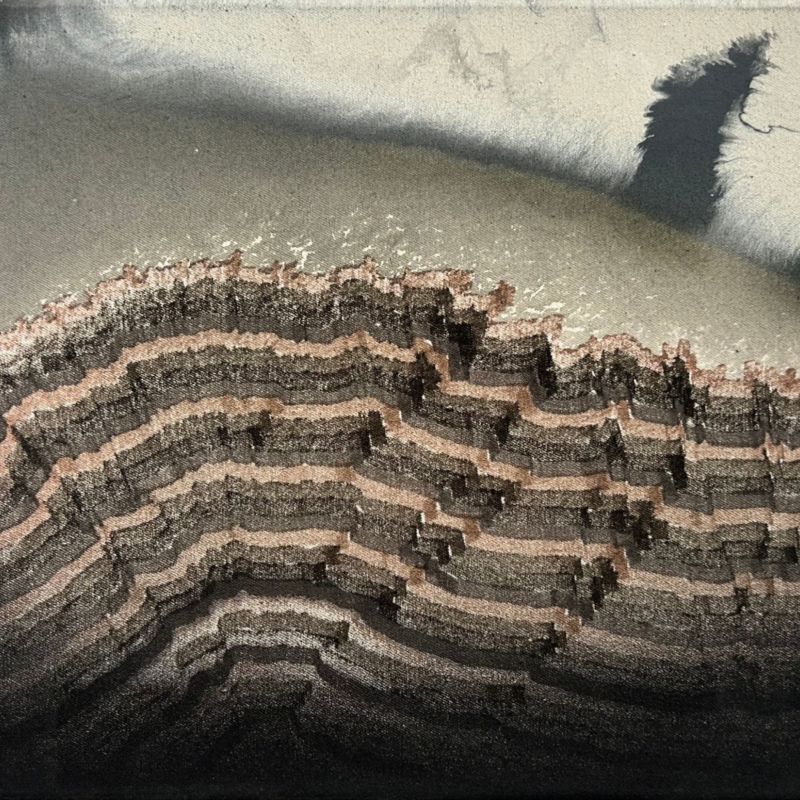
St. George's Week: Artists' Breakfast with Forum Box on 27 April
Monday 27 April, 2026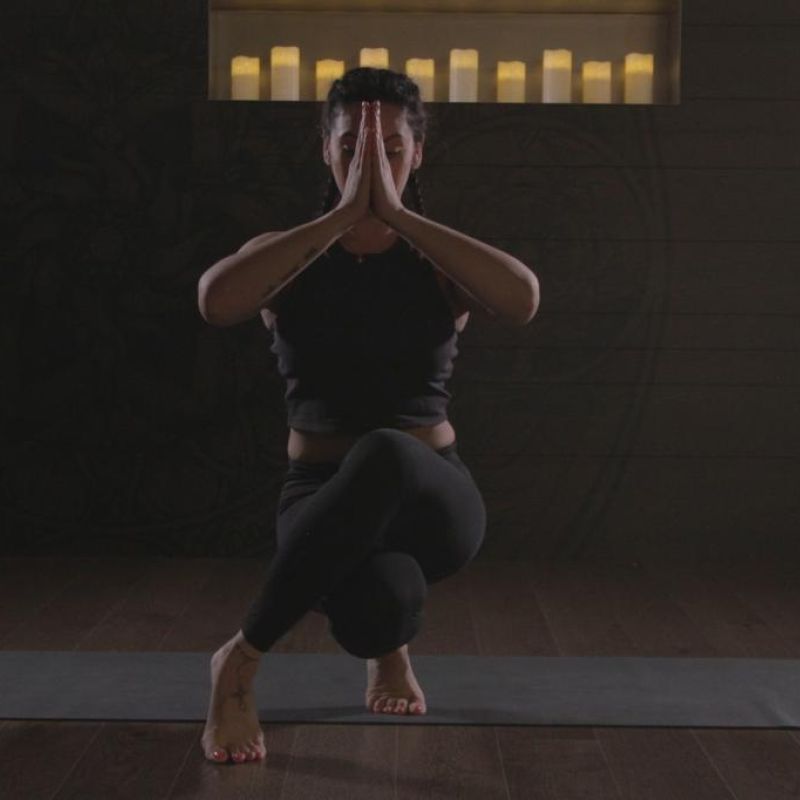
St. George's Week: Wintergarden Yoga
Saturday 25 April, 2026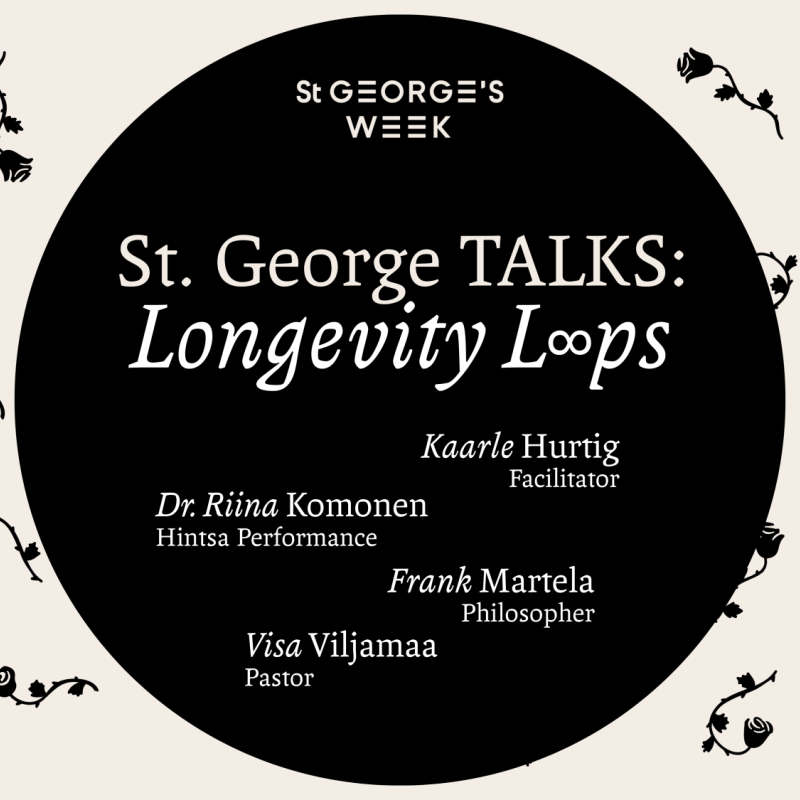
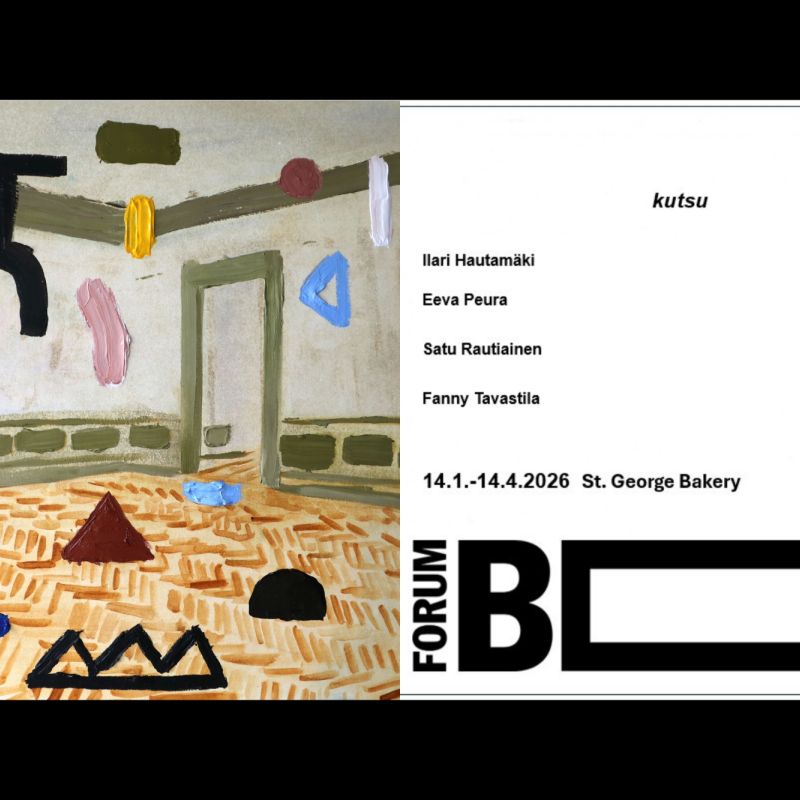
Forum Box: Kutsu / Invitation
Wednesday 14 January, 2026
FIFU x St. George: Old work. New life.
Thursday 01 January, 2026
Micro-moments of recharge: A tech founder’s 24 hours of calm

Living Like a Traveler, Traveling While Living: Tips for Travelers and Locals by Yumi Matsumoto

Curated by BOM: Inner Children
Thursday 04 September, 2025
Night of The Arts 2025 at St. George Bakery & St. George Wintergarden
Thursday 14 August, 2025
Helsinki Design Week 5–14 September – Can human happiness be designed?

Apply to a writers' residency in St. George by May 1st
Wednesday 23 April, 2025


Klaus Haapaniemi’s exhibition dives into the ocean depths

Coupole Suite Yoga on Friday, April 25 & Saturday, April 26
Friday 25 April, 2025
St. George invites guests to a unique scent experience in partnership with MALIA Company

Curated by BOM for St. George Bakery
Thursday 23 January, 2025
Coolcation Inspiration: Helsinki’s Hotel St. George sets the standard

St. George Bakery takes Finnish cinnamon buns to Japan – featured in a prestigious Christmas market

Mert Otsamo: Ephemeral Beauty
Saturday 07 September, 2024


St. George Residency x Photofuss: Dream Laboratory
Tuesday 23 April, 2024


Tales & Cocktails Tour on Feb 14, 2024
Wednesday 14 February, 2024
Sauna yoga on Nov 17 & 24, and Dec 9
Friday 17 November, 2023
Wintergarden's Flow Brunch on 12 August, 2023
Saturday 12 August, 2023
Wintergarden's Vegan May Day Brunch 1st of May 2023
Monday 01 May, 2023
Helsinki Biennial invites visitors to the treasure island of art
Tomi Björck opens a contemporary Asian restaurant at Hotel St. George





Helsinki’s art year 2020: from Van Gogh to archipelago adventures




Helsinki Festival Pre-Party with Ylva Haru
Thursday 22 August, 2019
Ravintola Andrea x Omara Portuondo
Saturday 24 August, 2019

Helsinki Summer Tips - Soak up summer like a Helsinki local



St. George's Party w/ Sami Pitkämö & Band, 26.4.
Wednesday 29 September, 2021

St. George's Party w/ Petteri Sariola 19.11.
Friday 19 November, 2021
St. George's Party w/ Pete Parkkonen 22.4. (siirtyy)
Friday 22 April, 2022
George TALK: Reaching Sustainable High Performance
Wednesday 20 March, 2019
The unknown design classic that invites you to relax: Arne Jacobsen's Paris Chair



Letting off steam: How to discover the perfect Helsinki sauna for you




St. George recommends: 5 x gift ideas for fathers

An art gallery in a hotel - Ai Weiwei’s dragon welcomes visitors to Hotel St. George
From newspapers to books: Hotel St. George is full of stories
Pekka Jylhä's "Learning to Fly" spreads its wings in Wintergarden
How chef superstar Mehmet Gürs came home to Helsinki
From national awakening to Nordic design: Hotel St. George echoes Helsinki’s history